Tech

Tomas Ramanauskas
Co-founder
,
A Phone A Friend
This device replaces apps with AI (A-Phone, A Friend)
Tomas Ramanauskas, co-founder of A Phone A Friend, on building an AI smartphone from Lithuania that replaces every app with a single conversational assistant.
Transcript
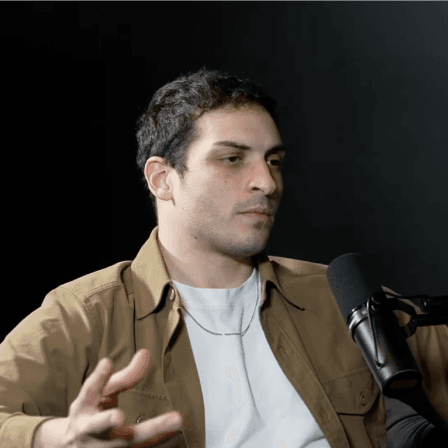
Manav: This is Thomas, and he lives all the way in Lithuania. Thomas, with his co-founder — also named Thomas — co-founded a company called Ono Friend, and they're trying to replace all apps with conversational AI.
[Ad/product clip]: "Let's build an AI smartphone which cares for you — like an actual friend who never leaves. Introducing a phone, a friend. It knows you, helps you, grows you, entertains you — it keeps everything in one flow, next to all of your apps. A smartphone which puts you, not the attention economy, at the center."
Manav: That's a pretty hard problem — you might have seen a lot of devices in the news lately, this one or that one, all of them coming out with a promise of replacing your iPhone. Why do you think conversational AI will kill apps first?
Thomas: Yes — me and my partner, also named Thomas, co-founder, so it's easy to remember. It comes from our own dissatisfaction with how we interact with smartphones — this relationship between us as users and smartphones, and the companies, the social media, and everything else built into them. We don't think it's a relationship of equals. We love our smartphones as humans — it's at the center of everything in the world, the smartphone is the center — but they don't love us back, or at least not enough, and we end up with anxiety, depression, all these things connected to overuse of smartphones.
We think AI has the potential to genuinely humanize technology, because no prior technology has offered this extremely intuitive, humanlike interaction — basically, it's conversation. It could be voice, it could be typing, it doesn't really matter — it's the way you naturally experience the world, talking to people, just talking or communicating. Apps aren't built that way, not all of them, right? We believe eventually apps will disappear — but if we tried to switch overnight, said "apps, bye-bye" tomorrow, that's actually one of the main issues with a lot of these new, exciting devices, like Rabbit AI and especially Humane — because Humane initially claimed you could just get rid of your phone entirely. We believe that's basically impossible. The phone, as it is now, we've essentially evolved alongside it — there's no clean way of just getting rid of the screen.
We can imagine a lot of interesting form factors — eyeglasses, sunglasses, other wearables — but you'll still need a screen for a lot of things. You need to see Instagram pictures, they're not going away, you need to take pictures of your loved ones, watch videos. These things are definitely staying, but they'll gradually evolve into different ways of experiencing them.
So our concept has a built-in "kill switch" — you can always flip back to your familiar, comfortable home screen of apps, the one you already know well, and then switch back into "AI friend" mode, which organizes information in a completely different way. Even with the amazing progress in AI, it's still going to be an evolution — we'll still need screens, we'll still need apps, they'll just gradually morph into something else. At least for the next decade, I don't see us getting rid of the phone entirely.
Manav: I'm pretty sure the iPhone isn't going to become obsolete, at least for the next decade. The problem right now is that most apps are clunky and require way too much effort to navigate, and I feel like the biggest issue right now is screen time and the anxiety these apps cause. So in this future trend you're describing, where people shift toward a "phone as a friend" and devices like that — how do you envision screen time actually going down using your device?
Thomas: The main thing we've observed — we looked at which apps actually make us happiest, and there's almost a perfect inverse correlation with how much screen time we spend on them. More time spent tends to make people less happy. The apps that don't follow that pattern tend to be simple tools — calendar, navigation — those are actually some of the best use cases.
One idea we have is something we call "Radio Friend." It's a fairly simple concept — AI-produced audio news, generated instantly, extremely personalized to your tastes, your preferences, whether you want more inspirational content or more grounded, realistic news. It's a step toward getting away from the screen entirely — listening, not reading. Text-to-speech isn't hard technically anymore, so the goal is less time looking and searching, and more time just listening, hands-free, getting exactly what you want.
The way to solve this, I think, is through voice, or simple conversational chat — you don't need a dedicated app for it. You can just say, like you mentioned earlier, "I need an Uber right now to go home," and it already knows everything it needs to act on that — you don't have to open an app and navigate menus.
That said, there'll be real pushback from app makers — take Uber, for example — because this kind of environment makes it harder for them to sell you a premium upsell or additional features through a clean voice interaction. Maybe they'll find a way to adapt, or we'll find the right dialogue with them on how to make it work, but if you just strip it down to pure voice, that removes a lot of nuance, and there's going to be some real friction between AI platforms like ours and the app companies themselves on how that gets resolved. I'm not sure exactly how long that'll take to sort out, but voice will definitely become the default for a lot of simple tasks.
One thing we've also noticed — it turns out not everyone actually likes controlling things by voice. Personally, I'm not that keen on speaking out loud everywhere I go, I feel like it invades my own private space a bit, I prefer typing. So there will always be two options, typing and talking. But the general idea behind "a phone, a friend" isn't that it becomes some fully humanlike entity — more that it's genuinely helpful, it can lift your mood, you can talk through things with it. As humans, we've moved from DVDs to streaming, from paper to countless other formats — and we'll make a similar shift here too. That's the amazing thing about people — we can never just sit quietly alone in a room, we always need to be doing something, and that gives us real room to build toward this.
Manav: There's a possibility that in the future we just have one conversational AI that we talk to, and it handles all our tasks, and we're not constantly bombarded with ads. What do you think — do you think all apps eventually get replaced by conversational AI, or does that still feel like a distant dream?