Tech
Real Estate

Justin Lu
Founder & CEO
,
Truckpedia
Justin Lu: Building A $20 Million Trucking Empire
Justin Lu on scaling his family trucking business from $1M to $20M in revenue, selling it, and building Truckpedia to help other truckers.
Transcript
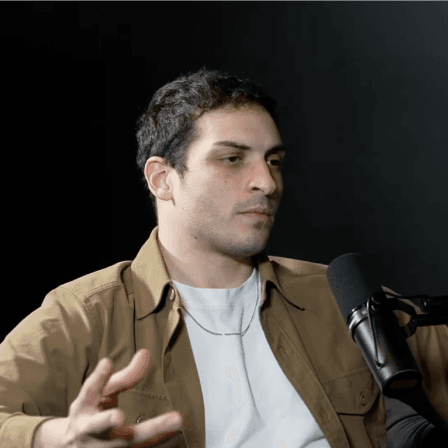
Manav: This is Justin, a second-generation trucker who scaled his dad's company from $1 million to $20 million in revenue — but it wasn't easy. He knocked on many doors to get more customers, and after numerous rejections, he finally found dedicated shippers to help scale his trucking company from 3 to 50 trucks. In 2021 he ended up selling the trucking company, and then decided to help other truckers with a software platform called Truckpedia.
All right guys, we have Justin Lu, the founder and CEO of Truckpedia, and today we're going to be talking about how Justin is disrupting the trucking industry. How are you doing, Justin?
Justin: Good, good, how are you?
Manav: Good to have you on the show. Justin, how did you get into the trucking industry?
Justin: I actually never wanted to be in trucking. I never really knew what I wanted to do as a kid, but I knew it wasn't going to be trucking, watching how old-school it was for my dad — being a trucker himself, always on the road, and when he came back, he was always buried in paperwork. It just didn't seem appealing to me, being in something that old-school.
Fast forward, I graduate college, join Amazon to help launch robotic warehouses — sounds cool, but what I actually realized is that I'd gotten myself into logistics. Anything you order from Amazon, say a water bottle, arrives in two days — but the truck carrying hundreds or thousands of those, we had zero visibility into where it was until it physically arrived at our warehouse. This was around 2018 — no visibility at all. That made me realize, wait a minute, my dad's industry isn't behind because he's slow — everybody in his industry is basically operating like a dinosaur.
So I decided to dig deep into the industry, and realized, wow, this is almost a trillion-dollar industry in the US alone. I left Amazon, joined my dad — he was struggling at the time, running about three trucks — and decided, honestly, I was also a bit tired of watching him struggle, and wanted to see what I could carve out for myself in the space. I left Amazon, joined my dad, and helped scale the company from 3 to 50 trucks in a little under three years. My original plan was to stay three years — I was 24 when I left Amazon, 27 by the time I hit that mark — then either go to business school or head back to the corporate world. Little did I know, once you're in trucking, you never really get out. I've been in the industry since I left Amazon in 2018.
Manav: I'm an immigrant myself, so I want to step back and ask about how your dad got into trucking, and how he came from China to the US — it must have been really hard with the language barrier. Can you talk about that?
Justin: Absolutely — it's kind of the classic story, living the American Dream, better education for us kids, a better life overall. He actually owned a trucking company back in China too, even before moving to the US. After arriving here, he saw people driving trucks on the road and thought, wait, I want to do this, I don't want to just work some other job for a company. This was around 2006 — he became a truck driver, and about a decade after driving for others, he decided to buy his own trucks.
He'd been saving the whole time, supporting a family of four — my mom stayed home taking care of us kids, my dad worked. Before my sister finished college, he really couldn't afford to take on the risk of starting his own business — what if it didn't work out, there was a whole family depending on him. So he waited until the timing was right, until the kids had graduated and were working on their own, and the financial pressure eased up, and then he started his own business.
It didn't go the way he expected, though — it was inconsistent, bouncing between one truck, three trucks, five trucks, back down to one, then up to three again. It's kind of like the stock market, honestly — when the market's doing well, everyone jumps in, and the moment you jump in, it dips and you get burned. People do the same thing in trucking.
Manav: Let's talk about when you joined your dad's company — he had three trucks. How did you scale to 50? Can you walk us through that journey step by step?
Justin: How we went from 3 to 50 really came down to bringing an outside perspective into trucking — I started challenging how the industry did things. I'm a huge fan of the first-principles thinking Elon Musk talks about — in an interview about building batteries, he broke it down to, batteries are expensive, so let's break everything down to the most fundamental elements and rebuild from there. I applied the same approach to trucking: do I really need a third party to help me if I'm afraid to do it myself? No, I can reach out myself.
So literally, I started driving around my own neighborhood, looking at warehouses, thinking, wait, why am I seeing trucks from out of state picking up from my own neighbors, people I've never even introduced myself to? Why am I not just saying hi? So I started driving around, introducing myself: "Hi, I'm Justin, I run a trucking company, I'm your neighbor, can we work together?" After about 20 to 50 rejections, finally I got a "sure, let's get to know each other," and I followed up — that's how I landed my first customer, who happened to ship medical equipment.
That's when I realized something important — if you search Google for "direct shippers" or "shipping companies," nothing meaningful comes up, because that's not how people search. But if you search "medical equipment conferences" or "medical equipment manufacturers" or "medical equipment warehouses," there's actual traffic there. So by narrowing down to one specific commodity, my message got a lot more powerful. I decided I wasn't going to knock on any door besides medical equipment warehouses, and my website was entirely built around being a medical equipment trucking company.
When I approached someone as "a trucking company that only carries medical equipment," I stood out immediately — these warehouses get so many people knocking, calling, saying "we're a freight broker" or "we're a big trucking company." But I came in saying, "I'm a medical equipment shipping specialist" — a niche trucking company specifically for medical equipment — and they liked that. I turned a couple of those customers into loyal, consistent accounts through good service, then asked them, "hey, we're growing, do you know anyone else in the industry?" Truckers know a lot of truckers, and shippers know a lot of shippers — if they have shipping needs, chances are their friends do too.
Manav: Did you go to trucking conferences too?
Justin: Absolutely — there are really two broad channels, inbound and outbound marketing. Knocking on doors is one channel, conferences are another. Which conferences you go to really depends on your goal — if you want to see the latest technology, you go to a trucking tech conference. But if, say, you specialize in shipping plastics, you go to a plastics industry conference to find shippers who need your specific service. You have to think outside the box: where does my actual customer already gather, and how do I pitch myself so I stand out? If you're just "a trucking company" reaching out cold, versus someone who says, "I carry nothing but plastics," the second one comes across as an expert, and people are far more likely to trust and engage with that.
Manav: Let's talk about Truckpedia now — explain it to me like I'm five. It seems like it's either a marketplace or a CRM, or maybe both — what exactly is it?
Justin: It's both, honestly — it's an operating system, in a way. Trucking owners are usually too busy focused on what I call the "$5 tasks" — data entry, invoicing, dispatching, record keeping — all done manually. Truckpedia is a system that automates as much of that as possible, so you always know your actual profit margin, and you can automate and delegate tasks to your team without ever losing visibility as the owner.
On top of that, it's a marketplace — it lets trucking companies list their available capacity: "these are the lanes I run, this is what I want to charge," and market that directly to customers to help scale their business.
Manav: How do drivers actually get paid — per mile?
Justin: There are really only three common ways drivers get paid: per mile, by percentage, or —
Manav: Salary.
Justin: Exactly, salary. Truckpedia supports all of them — you can track and manage driver pay through the platform, which is another piece that eats up a lot of a trucking company's time. Imagine you've got 50 drivers — manually calculating pay for every single one, every week, is basically a part-time job, 20 hours a week. Truckpedia automates that whole process for you.
Manav: Did you guys raise money for Truckpedia?
Justin: We did, and there's actually a story to it. I was posting on LinkedIn originally to attract customers — trucking companies — sharing my own story about how I scaled the company, how I found shippers, how I improved margins. What I didn't expect was that writing on LinkedIn also attracted investors — VCs started messaging me, maybe one or two a week. I started talking to them, thought, sure, why not, let's see what you've got.
Early on, though, like with anything new, I genuinely didn't know what I was doing — I didn't even know what valuation meant, really. I'd just go through my pitch on every call, talk about what I wanted to build, and by the end of the conversation it'd always be, "okay, I'll bring this back to my team, let you know if there's a next step" — and then radio silence. That's when I realized, clearly there's something I'm doing wrong here, and I started learning about the power of storytelling.
How do you tell a compelling story that actually hooks people? Fundraising really is storytelling — how well can you tell a story that makes people believe in what you're doing, showing genuine passion while you explain it, so they think, "this is the person." It's not really about the product itself, it's about who's the person behind building it. I ditched the pitch deck entirely — just sent people basic info, said, "take a look before we talk, and if you haven't looked at it beforehand, you're probably not the investor I want to be talking to."
Everything changed once I started leading with the story instead — like we talked about earlier: "hey, second-generation trucker, wanted nothing to do with trucking, ends up scaling from 3 to 50 trucks, 7% to 20% profit margin, $20 million in revenue." Throwing numbers like that at people makes them go, "wait, this is actually interesting." I frame it as, I fixed this problem for myself, and now I'm trying to help the other 90% of the industry fix the same thing. Through friend referrals and conversations, we actually got our first check very fast — within about a month of people reaching out, we had an offer, and we used that first check to help land a bigger one. Honestly, I didn't have to put in a ton of effort into fundraising itself.
Manav: What's the business model for Truckpedia — is it a SaaS model where you charge both sides, a monthly listing fee, that kind of thing?
Justin: I love that you brought that up — Truckpedia is not a broker, and what really makes it unique is that we don't mark up a single shipment. We don't charge shippers, and we don't charge brokers. Who we do charge is the trucking company — usually, depending on company size, somewhere around $200 to $300 a month, for a platform that runs essentially your entire operation. That's incredibly cost-effective — you can't hire anyone for a few hundred bucks a month, and regardless, the system can handle far more than a single person could for your business. From an ROI standpoint, we want customers getting at least 10x back on what they're paying us.
Manav: Let's quickly talk about the future of Truckpedia.
Justin: Our goal isn't just to serve trucking companies and shippers in the US — we want to go worldwide. We're already getting a lot of requests from customers in Mexico, shippers who want to move goods from Mexico to the US and vice versa, and into Canada as well. So Truckpedia is expanding pretty quickly beyond just the US — we're onboarding trucking companies from Mexico onto the platform, onboarding shippers and freight forwarders too, so we can connect all of them and facilitate shipments basically anywhere.
Manav: What advice do you have for other young entrepreneurs starting out — how should they pick an idea to build a business around? Let's talk about hard work for a second.
Justin: Pick the most "unsexy" industry nobody else wants to touch — that's often where the real opportunity is. Second, don't wait — there's never a perfect time to get started, just get started, whatever the idea is. Start talking to customers, test whether the idea actually resonates, see if people are willing to pay for it. Don't be embarrassed about launching your first version, even if it's rough — that's okay, get it to market. If people are willing to pay for it, that tells you you're solving a real problem. If you don't have a paying customer, you're probably not solving the right problem yet.
I think the most common mistake people make is staying in stealth mode. Regardless of your idea, your product a year from now is going to look very different from where it started anyway — so don't be afraid to share it early. Most people won't copy your idea, and even if they do, it's all about execution — how well and how fast can you actually talk to customers, and how much real impact can you make on their lives. Just ignore the outside noise and get started.
Manav: All right guys, thank you so much for watching, we filmed another great interview today — be sure to like and subscribe, and go follow Justin. Where can people find you?
Justin: Mostly on LinkedIn — just search Justin Lu, Truckpedia, and you'll find me. I share a lot of insights, especially aimed at trucking companies, and for anyone with shipping needs, connect with me, happy to share more resources. And if you know any shipping or trucking companies, tell them about Truckpedia — help someone out.
Manav: All right guys, thank you so much, I'll see you in the next one.